
Friday, October 31, 2008
A Good Paragraph; Bell Jar
Esther Greenwood, a college student, has a very strong desire to have sex. She lost her virginity with Dr. Irwin, a math professor. After having sex, Esther realized she was bleeding profusely. Joan, one of Esther's best friends, took her to the hospital to get cheked out. The doctor said it was unusual to lose too much blood after the first sexual intercourse. Days later, Esther received the bad news that her friend, Joan, committed suicide by hanging herself. Esther felt she would not be able to reinstate of what she have been through. Esther called Irwin to tell him to pay her doctor's bill after what happened with her. Esther had to attend the funeral of one of her best friends, Joan. This part of the story can be categorized as the Ordeal. At the end of the story, Esther is waiting to be interviewed by her doctors to see if she can leave the asylum.

Thursday, October 30, 2008
Vogler's Annotated Bibliography (Stage Nine: Reward & Stage Ten: The Road Back)
Vogler, Christopher. “Book Two: Stages of the Journey-Reward & The Road Back.” The Writer’s Journey: Mythic Structure for Writers. 3rd Edition. Studio City, CA: Michael Wiese Productions, 2007. 175-194.
Summary
Right after the hero passed through the Ordeal, it is time for him to claim his reward. The hero has now gained experiences and it is different; he has changed. It is very common for heroes to want to celebrate after they have survived death (176). Sometimes there is an opportunity for the hero to have a love scene; a hero may get married at this point. It is also the time for the hero to get what he/she was looking for. Seizing the Sword is when the hero aggressively takes possession of whatever was being sought in the Special World (178). Heroes expect to be recognized as special and different, because they survived death (179). When heroes survive death they perceive things in a different way. They are more aware of things; they become more intuitive (181). In some cases the hero may experience a sense of greatness, what it is called epiphany. After a moment of supreme Ordeal, they feel like they are divine, like a sacred being (181).
Having what he/she was looking for, the hero is in his Road Back to the Ordinary World, if that was the decision. Some heroes decide to stay in the Special World, but most of the go back home. At this point, heroes can use what they learned in the Special World for their own benefit. The Road Back marks a time when heroes rededicate themselves to the adventure (189). There are cases in which heroes leave the Special World because they are running for their lives. These are called chase scenes (191). Another way for the hero to go back to the Ordinary Word is by the magic flight. Another twist of the Road Back maybe a sudden catastrophic reversal of the hero’s good fortune (192). Sometimes the hero may encounter setbacks that call them into an adventure again. While in the Road Back, heroes may set themselves a new goal to achieve, maybe to escape, or to return home (193). Resurrection is the next step that a hero needs to pass before the end of the journey.
Reaction
I really liked these two past sections, because Vogler explains everything so detailed and clear that it is very easy for me to follow through and understand. In a personal experience, after I graduated from high school I felt that I had to be known as special, because I was successful even though I had a hard time with the language of English. In my case death was not graduating, and I survived it. I decided to stay in the Special World, Florida, because I wanted to test myself again by going to college. I decided to use the experience and knowledge gained in the past to help me with my college journey. As Vogler explains every section, I can relate it to my experience of moving to the United States. It feels wonderful to know that I was a hero at a certain point in my life.
Questions
1. What do you think heroes get from their experiences of facing death?
2. What have you gained from a failing experience, or maybe from a life-threatening experience?
3. In one of your personal experiences, did you decided to stay into the Special World? Why? Why not?

Summary
Right after the hero passed through the Ordeal, it is time for him to claim his reward. The hero has now gained experiences and it is different; he has changed. It is very common for heroes to want to celebrate after they have survived death (176). Sometimes there is an opportunity for the hero to have a love scene; a hero may get married at this point. It is also the time for the hero to get what he/she was looking for. Seizing the Sword is when the hero aggressively takes possession of whatever was being sought in the Special World (178). Heroes expect to be recognized as special and different, because they survived death (179). When heroes survive death they perceive things in a different way. They are more aware of things; they become more intuitive (181). In some cases the hero may experience a sense of greatness, what it is called epiphany. After a moment of supreme Ordeal, they feel like they are divine, like a sacred being (181).
Having what he/she was looking for, the hero is in his Road Back to the Ordinary World, if that was the decision. Some heroes decide to stay in the Special World, but most of the go back home. At this point, heroes can use what they learned in the Special World for their own benefit. The Road Back marks a time when heroes rededicate themselves to the adventure (189). There are cases in which heroes leave the Special World because they are running for their lives. These are called chase scenes (191). Another way for the hero to go back to the Ordinary Word is by the magic flight. Another twist of the Road Back maybe a sudden catastrophic reversal of the hero’s good fortune (192). Sometimes the hero may encounter setbacks that call them into an adventure again. While in the Road Back, heroes may set themselves a new goal to achieve, maybe to escape, or to return home (193). Resurrection is the next step that a hero needs to pass before the end of the journey.
Reaction
I really liked these two past sections, because Vogler explains everything so detailed and clear that it is very easy for me to follow through and understand. In a personal experience, after I graduated from high school I felt that I had to be known as special, because I was successful even though I had a hard time with the language of English. In my case death was not graduating, and I survived it. I decided to stay in the Special World, Florida, because I wanted to test myself again by going to college. I decided to use the experience and knowledge gained in the past to help me with my college journey. As Vogler explains every section, I can relate it to my experience of moving to the United States. It feels wonderful to know that I was a hero at a certain point in my life.
Questions
1. What do you think heroes get from their experiences of facing death?
2. What have you gained from a failing experience, or maybe from a life-threatening experience?
3. In one of your personal experiences, did you decided to stay into the Special World? Why? Why not?
Tuesday, October 21, 2008
Strengths and weaknesses regarding to my focus development
Strengths:
- Relating the paper to my personal experiences to show the reader insight into my topic
- Trying to show that although high school dropout rates among hispanics are high, there are others that succeed
- Going to interview a teacher that teaches English to ESL students (my teacher from high school)
Weaknesses:
- Bring more ratios about hispanic high school dropout rates
- Instead of looking for "hispanics", it will be better to look for "hispanic immigrants" that know English as their second language
- Look for more facts about those who have succeeded in high school

- Relating the paper to my personal experiences to show the reader insight into my topic
- Trying to show that although high school dropout rates among hispanics are high, there are others that succeed
- Going to interview a teacher that teaches English to ESL students (my teacher from high school)
Weaknesses:
- Bring more ratios about hispanic high school dropout rates
- Instead of looking for "hispanics", it will be better to look for "hispanic immigrants" that know English as their second language
- Look for more facts about those who have succeeded in high school
Monday, October 20, 2008
Vogler's Annotated Bibliography (Stage Seven: Approach to the Inmost Cave & Stage Eight: The Ordeal)
Vogler, Christopher. “Book Two: Stages of the Journey- Stage Seven: Approach to the Inmost Cave & Stage Eight: The Ordeal." The Writer’s Journey: Mythic Structure for Writers. 3rd Edition. Studio City, CA: Michael Wiese Productions, 2007. 143-173.
Summary
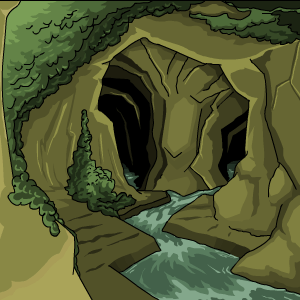
The time to wonder around, make allies, and gain enemies is over. Now hero is getting closer and closer to the most dangerous and supreme parts of his journey while approaching the Inmost Cave. Sometimes when the hero is approaching the Inmost Cave, a romance may occur, so the hero can get something good out of the harsh situation. This is the time for the hero to make the last arrangements, get all the information needed, and have his army ready (if it is the case). Obstacles and challenges are part of the journey, so the hero must be ready for them. A hero can't fall asleep on the march; he needs to stay alert at all times (145). The Inmost Cave makes the hero focus in his main goal, but also reminds the " time bomb" to audience (149). When heroes are alone and have nobody to help them achieve their goals, they need to re-organize themselves, and maybe look for help if needed. Heroes get help from mentors, but sometimes there are situations in which mentors cannot go where the hero is going, and the hero must be on his own (150). Mentors guide the heroes and support them, but the hero must do the rest. Now is time for the hero to relax for a while and take a deep breath, because things are going to get serious (151).
Being in the deepest part of the Inmost Cave, the hero is now at the Ordeal stage. In the Ordeal, heroes must die so that they can reborn (155). When heroes die at this stage, they do not just live again and things become happy. A hero changes, gains knowledge, experiences, and becomes a better hero. The Ordeal can lead to a wide variety of situations to happen, it leads to the climax of the story. After a crisis, a hero is reborn in the sense of his character; he gets stronger and wise. When the hero appears to die, or actually dies, there is always a witness watching. This witness gets really sad when the hero "dies", but then is extremely happy when the hero revives (159). The audience wonders if the hero is ever going to get up, if he is still alive. Heroes get a pretty good taste of death. As humans, we like to experience danger, because sometimes it feels good. Vogler explains that people pay good money for a taste of death, and I totally agree with that. For example, people go to Busch Gardens to get into those humongous rides, like Sheikra. People enjoy being there, very high, and going as fast as the wind. Is is very common in a story when a hero comes close to the Ordeal, and the villain is the one that actually dies (164). When heroes get a pretty good taste of death, their ego dies. Tasting dead lets you sit in God's chair for a while (171).
Reation
I really liked these two chapters of Vogler, because although the content was pretty wide and somehow difficult for me to understand, he gave perfect examples that really helped me. These two reading are the most interesting ones that I have read so far from the Vogler's book. The content in these two chapters is very deep, and there were a lot of information that I never heard before. I can relate the chapter about the Inmost Cave with my own experience when moving to the United States. Vogler explains that a hero cannot fall asleep on the march; that it needs to keep going. That is totally true, because it was very hard for me to keep going on and being under pressure with a new language, but if I did not continue I could not achieve my main goal that was graduation. The stage of the Ordeal is one of the most explosives parts of any story. I hate when a hero appears to die, and the audience is biting their nails, and wondering if the hero is going to wake up. Vogler was right when talking about how humans pay good money for a taste of death. I am like that, I go to Busch Gardens and the first thing that I do is to go straight to Sheikra. Yes, I am scared at first, but the feeling of being high up there is amazing.
Disussion Questions
1. Have you had any big obstacles when approaching the Inmost Cave during a personal experience?
2. How do you think dead and rebirth may change a hero? What changes in him?
3. In what movies have you seen this example of dead and rebirth of a hero? What was your reaction?
Summary
The time to wonder around, make allies, and gain enemies is over. Now hero is getting closer and closer to the most dangerous and supreme parts of his journey while approaching the Inmost Cave. Sometimes when the hero is approaching the Inmost Cave, a romance may occur, so the hero can get something good out of the harsh situation. This is the time for the hero to make the last arrangements, get all the information needed, and have his army ready (if it is the case). Obstacles and challenges are part of the journey, so the hero must be ready for them. A hero can't fall asleep on the march; he needs to stay alert at all times (145). The Inmost Cave makes the hero focus in his main goal, but also reminds the " time bomb" to audience (149). When heroes are alone and have nobody to help them achieve their goals, they need to re-organize themselves, and maybe look for help if needed. Heroes get help from mentors, but sometimes there are situations in which mentors cannot go where the hero is going, and the hero must be on his own (150). Mentors guide the heroes and support them, but the hero must do the rest. Now is time for the hero to relax for a while and take a deep breath, because things are going to get serious (151).
Being in the deepest part of the Inmost Cave, the hero is now at the Ordeal stage. In the Ordeal, heroes must die so that they can reborn (155). When heroes die at this stage, they do not just live again and things become happy. A hero changes, gains knowledge, experiences, and becomes a better hero. The Ordeal can lead to a wide variety of situations to happen, it leads to the climax of the story. After a crisis, a hero is reborn in the sense of his character; he gets stronger and wise. When the hero appears to die, or actually dies, there is always a witness watching. This witness gets really sad when the hero "dies", but then is extremely happy when the hero revives (159). The audience wonders if the hero is ever going to get up, if he is still alive. Heroes get a pretty good taste of death. As humans, we like to experience danger, because sometimes it feels good. Vogler explains that people pay good money for a taste of death, and I totally agree with that. For example, people go to Busch Gardens to get into those humongous rides, like Sheikra. People enjoy being there, very high, and going as fast as the wind. Is is very common in a story when a hero comes close to the Ordeal, and the villain is the one that actually dies (164). When heroes get a pretty good taste of death, their ego dies. Tasting dead lets you sit in God's chair for a while (171).
Reation
I really liked these two chapters of Vogler, because although the content was pretty wide and somehow difficult for me to understand, he gave perfect examples that really helped me. These two reading are the most interesting ones that I have read so far from the Vogler's book. The content in these two chapters is very deep, and there were a lot of information that I never heard before. I can relate the chapter about the Inmost Cave with my own experience when moving to the United States. Vogler explains that a hero cannot fall asleep on the march; that it needs to keep going. That is totally true, because it was very hard for me to keep going on and being under pressure with a new language, but if I did not continue I could not achieve my main goal that was graduation. The stage of the Ordeal is one of the most explosives parts of any story. I hate when a hero appears to die, and the audience is biting their nails, and wondering if the hero is going to wake up. Vogler was right when talking about how humans pay good money for a taste of death. I am like that, I go to Busch Gardens and the first thing that I do is to go straight to Sheikra. Yes, I am scared at first, but the feeling of being high up there is amazing.
Disussion Questions
1. Have you had any big obstacles when approaching the Inmost Cave during a personal experience?
2. How do you think dead and rebirth may change a hero? What changes in him?
3. In what movies have you seen this example of dead and rebirth of a hero? What was your reaction?
Saturday, October 11, 2008
Vogler's Annotated Bibliography (Stage Five: Crossing the First Threshold & Stage Six: Tests, Allies, Enemies)
Vogler, Christopher. “Book Two: Stages of the Journey- Stage Five: Crossing the First Threshold & Stage Six: Tests, Allies, Enemies.” The Writer’s Journey: Mythic Structure for Writers. 3rd Edition. Studio City, CA: Michael Wiese Productions, 2007. 127-141.
Summary
After meeting with the Mentor and deciding to go into the special world, the hero needs to cross the First Threshold. This may happen as a result of a villain killing, harming, threatening, or kidnapping someone close to the hero (128). Vogler also explains that hero's internal events may trigger him to cross the Threshold; "Do I go on living my life as I always have, or will I risk everything in the effort to grow and change?" (128). When a hero approaches the Threshold he is likely to face someone that is blocking his way, the Threshold Guardian. It is the hero's job to deal with the Threshold Guardian and pass through. A hero is at the border of two worlds when it is actually crossing the Threshold (129). A hero must have a lot of courage to take that big step and start crossing the Threshold, that special courage is called making the leap of faith (130). However, a hero's landing is not always as good as they expect; their arrival to the special world may be exhausting, frustrating, or disorienting (130).
There is a big difference between the Ordinary World and the Special World. Within the Special World, a hero experiences a series of tests. Now is the time for the hero to have company during his journey. Within the Special World a hero makes Allies and Enemies. This process is also a kind of test, because it examines the hero's good judge of character (137). One common type of Ally is a sidekick, an Ally who generally goes with the hero wherever he goes, and supports him in all his adventures (137). A hero does not necessarily have just one Ally; it can also form a team with special skills that may help the hero to be successful in his journey. Although rivals are annoying, they are the ones that keep the story rolling. Enemies are a big part of a hero's journey, and they can also become the Shadow, the Trickster, and even the Herald (138). One interesting thing that Vogler mentioned was the fact that heroes often pass through bars and saloons when they first go into the Special World. Why is that? Bars are natural places to get better after the harsh landing into the Special World, pick up some gossip, chat with new people, and confront enemies (139).
Reaction
Now the story is actually beginning. This is one of the best parts of the movie, when the hero starts going into his journey. I really liked how Vogler stated that internal events within a hero could also influence him to cross the First Threshold. It is also very true that that a hero's landing may be harsh for him, because I can relate that to my own personal experience when I first moved to the United States, and I felt very disoriented in a completely new place. I think one of the hardest parts of a story is when a hero is trying to find someone to be his companion during his journey. I totally agree with Vogler when he says that the process of making Allies is a type of test; a hero has to be very smart to consider someone his Ally. I had never pay attention to the fact that heroes go to bars after they landed to the Special World. In the movie Snow Dogs, the main character to the movie goes to a type of bar when he arrived into Alaska. In there, he started meeting new people, and almost half of them ended being his Allies. In general, I really enjoy how Vogler explains every single detail of all he says in his book. All the information given help us to better understand stories, and also to evaluate and analyze stories that we have seen before.
Discussion Questions
1. During a personal journey, what made you cross the First Threshold in one of your experiences or journeys?
2. In your own life, have any of your landings into the Special World was difficult, and you felt disoriented at a certain point?
3. What qualities or characteristics do you think a hero must look for when looking for an Ally?

Summary
After meeting with the Mentor and deciding to go into the special world, the hero needs to cross the First Threshold. This may happen as a result of a villain killing, harming, threatening, or kidnapping someone close to the hero (128). Vogler also explains that hero's internal events may trigger him to cross the Threshold; "Do I go on living my life as I always have, or will I risk everything in the effort to grow and change?" (128). When a hero approaches the Threshold he is likely to face someone that is blocking his way, the Threshold Guardian. It is the hero's job to deal with the Threshold Guardian and pass through. A hero is at the border of two worlds when it is actually crossing the Threshold (129). A hero must have a lot of courage to take that big step and start crossing the Threshold, that special courage is called making the leap of faith (130). However, a hero's landing is not always as good as they expect; their arrival to the special world may be exhausting, frustrating, or disorienting (130).
There is a big difference between the Ordinary World and the Special World. Within the Special World, a hero experiences a series of tests. Now is the time for the hero to have company during his journey. Within the Special World a hero makes Allies and Enemies. This process is also a kind of test, because it examines the hero's good judge of character (137). One common type of Ally is a sidekick, an Ally who generally goes with the hero wherever he goes, and supports him in all his adventures (137). A hero does not necessarily have just one Ally; it can also form a team with special skills that may help the hero to be successful in his journey. Although rivals are annoying, they are the ones that keep the story rolling. Enemies are a big part of a hero's journey, and they can also become the Shadow, the Trickster, and even the Herald (138). One interesting thing that Vogler mentioned was the fact that heroes often pass through bars and saloons when they first go into the Special World. Why is that? Bars are natural places to get better after the harsh landing into the Special World, pick up some gossip, chat with new people, and confront enemies (139).
Reaction
Now the story is actually beginning. This is one of the best parts of the movie, when the hero starts going into his journey. I really liked how Vogler stated that internal events within a hero could also influence him to cross the First Threshold. It is also very true that that a hero's landing may be harsh for him, because I can relate that to my own personal experience when I first moved to the United States, and I felt very disoriented in a completely new place. I think one of the hardest parts of a story is when a hero is trying to find someone to be his companion during his journey. I totally agree with Vogler when he says that the process of making Allies is a type of test; a hero has to be very smart to consider someone his Ally. I had never pay attention to the fact that heroes go to bars after they landed to the Special World. In the movie Snow Dogs, the main character to the movie goes to a type of bar when he arrived into Alaska. In there, he started meeting new people, and almost half of them ended being his Allies. In general, I really enjoy how Vogler explains every single detail of all he says in his book. All the information given help us to better understand stories, and also to evaluate and analyze stories that we have seen before.
Discussion Questions
1. During a personal journey, what made you cross the First Threshold in one of your experiences or journeys?
2. In your own life, have any of your landings into the Special World was difficult, and you felt disoriented at a certain point?
3. What qualities or characteristics do you think a hero must look for when looking for an Ally?
Thursday, October 2, 2008
Kafka's Quiz
1. Gregor Samsa wakes up from an anxious dream, and finds out he has been transformed into a horrible bug. His Ordinary World goes away when he becomes aware of what have happened to him. His Ordinary World was based in living with his family (his father, mother, and sisters), and working very hard as a traveling salesman to get his parents out of debt. Gregor's Call to Adventure occurred when he had to stand up from his bed and go to work as a traveling salesman, but also to face others with his new transformation. He was terrified by the horrible creature he just turn into. He did wanted to take the train and go to work, but it was his radical transformation what was holding him from going to work.
2. A social issue being critiqued in the story is the fact that people sometimes go crazy with their jobs. People become addicted to the jobs, and they do not even pay attention to their own personal problems. In the story, Gregor is more concerned about going to work than what have just happened to him. This shows that they have changed their priorities in life. I personally think that is really bad, because it is okay to be responsible and go to work and be on time, but becoming obsessed with your job and putting yourself in the last number of your priority list, that is not good. This story relates to the "Red Scare" because the people were scared of Communists, and there was not actual threat or danger. Gregor's parents, and his boss are scared of him and think he is a threat to the society. Wasn't Gregor also scared? That situation must be hard for him.
3. Gregor turned into a bug.

2. A social issue being critiqued in the story is the fact that people sometimes go crazy with their jobs. People become addicted to the jobs, and they do not even pay attention to their own personal problems. In the story, Gregor is more concerned about going to work than what have just happened to him. This shows that they have changed their priorities in life. I personally think that is really bad, because it is okay to be responsible and go to work and be on time, but becoming obsessed with your job and putting yourself in the last number of your priority list, that is not good. This story relates to the "Red Scare" because the people were scared of Communists, and there was not actual threat or danger. Gregor's parents, and his boss are scared of him and think he is a threat to the society. Wasn't Gregor also scared? That situation must be hard for him.
3. Gregor turned into a bug.
Wednesday, October 1, 2008
Revising and Editing
3 elements to revise:
*unpack information
*use of FANBOYS
*some grammar errors
3 elements to edit:
* use transitions to make the reader part of the journey
* make sure to guide the reader
* Be careful with the "it", "its", etc..

*unpack information
*use of FANBOYS
*some grammar errors
3 elements to edit:
* use transitions to make the reader part of the journey
* make sure to guide the reader
* Be careful with the "it", "its", etc..
Vogler's Annotated Bibliography (Stage Three: Refusal of the Call & Stage Four: Meeting with the Mentor)
Vogler, Christopher. “Book Two: Stages of the Journey-Stage Three: Refusal of the Call & Stage Four: Meeting with the Mentor.” The Writer’s Journey: Mythic Structure for Writers. 3rd Edition. Studio City, CA: Michael Wiese Productions, 2007. 107-126.
Summary
We have already talked about the Hero, his Ordinary World, and his Call to Adventure. Now it is time for the Hero to jump into a new world full of experiences and adventures he have never faced before. This decision to actually go and face a new world may be very hard for the Hero. The Refusal of the Call is when a Hero refuses to go into the Special World. At some point we are also refusing to jump into a new adventure, like college for example, because we are afraid that things are going to get hard or that we are still not ready for such a big change. According to Vogler, they refuse the call by listing a “laundry list” of weak excuses (108). However, sometimes it is smart to refuse some Calls that may not benefit us. There is also the case of some heroes that will accept the Call without thinking twice. Willing heroes do not hesitate or have any fears about new adventures (110).
When a Hero is uncertain about whether accepting, or refusing the call, they need advice and support from a wise person. A Mentor is the person in charge for protecting, guiding, teaching, testing, training, and providing magical gifts to the Hero (117). By meeting with the Mentor the Hero gains confidence, and has a better chance of accepting the Call to go into the Special World. It seems like the relationship between the Hero and the Mentor is very solid. However, when the Hero is ungrateful with the Mentor, then the Mentor-hero relationship can take a drastic turn (121). Mentors are not just people that were born with all the knowledge and experiences that they have. The can be regarded as heroes who have become experienced enough to teach others (122).
Reaction
I like how Vogler explains to us how the Hero may react after the Call to Adventure. I can put myself into the hero’s shoes, because when I received the Call that I was going to move to the United States I was very worried, and also scared things we going to go wrong. It is not easy to be in that situation where you have to think very smart about what are you going to do. I loved when Vogler’s said that the Hero lists a “laundry list” of weak excuses. That is very true, and I can relate to that because sometimes we do not want to do something new just because we are afraid of it since we have never experienced before. Mentors exist everywhere; they are here at Eckerd College, and I have one. When I think about a Mentor I visualize my mother, because she helps me with all my concerns, and helps me to make wise decisions in my life. I also liked a lot when Vogler stated that Mentors can be regarded as heroes who have become experienced enough to teach others. Mentors had also rough times while in their journey, and probably got help from other mentors. Those rough times made them gain new experiences and learn new things, so that they could be able to help others using the knowledge previously gained.
Questions:
1. What do you think is the main excuse that heroes have to refuse the Call?
2. Have you had any situation in your life where you refused a Call because it was not good at all, or it was for some other purpose?
3. Do you think mentors are important in our life? Why?

Summary
We have already talked about the Hero, his Ordinary World, and his Call to Adventure. Now it is time for the Hero to jump into a new world full of experiences and adventures he have never faced before. This decision to actually go and face a new world may be very hard for the Hero. The Refusal of the Call is when a Hero refuses to go into the Special World. At some point we are also refusing to jump into a new adventure, like college for example, because we are afraid that things are going to get hard or that we are still not ready for such a big change. According to Vogler, they refuse the call by listing a “laundry list” of weak excuses (108). However, sometimes it is smart to refuse some Calls that may not benefit us. There is also the case of some heroes that will accept the Call without thinking twice. Willing heroes do not hesitate or have any fears about new adventures (110).
When a Hero is uncertain about whether accepting, or refusing the call, they need advice and support from a wise person. A Mentor is the person in charge for protecting, guiding, teaching, testing, training, and providing magical gifts to the Hero (117). By meeting with the Mentor the Hero gains confidence, and has a better chance of accepting the Call to go into the Special World. It seems like the relationship between the Hero and the Mentor is very solid. However, when the Hero is ungrateful with the Mentor, then the Mentor-hero relationship can take a drastic turn (121). Mentors are not just people that were born with all the knowledge and experiences that they have. The can be regarded as heroes who have become experienced enough to teach others (122).
Reaction
I like how Vogler explains to us how the Hero may react after the Call to Adventure. I can put myself into the hero’s shoes, because when I received the Call that I was going to move to the United States I was very worried, and also scared things we going to go wrong. It is not easy to be in that situation where you have to think very smart about what are you going to do. I loved when Vogler’s said that the Hero lists a “laundry list” of weak excuses. That is very true, and I can relate to that because sometimes we do not want to do something new just because we are afraid of it since we have never experienced before. Mentors exist everywhere; they are here at Eckerd College, and I have one. When I think about a Mentor I visualize my mother, because she helps me with all my concerns, and helps me to make wise decisions in my life. I also liked a lot when Vogler stated that Mentors can be regarded as heroes who have become experienced enough to teach others. Mentors had also rough times while in their journey, and probably got help from other mentors. Those rough times made them gain new experiences and learn new things, so that they could be able to help others using the knowledge previously gained.
Questions:
1. What do you think is the main excuse that heroes have to refuse the Call?
2. Have you had any situation in your life where you refused a Call because it was not good at all, or it was for some other purpose?
3. Do you think mentors are important in our life? Why?
Subscribe to:
Comments (Atom)